
Case Studies
We invite community discussion about transformational games, educational data mining, learning evaluation, and participatory standards development to understand how people learn with games.
Ways to Join the Conversation
User stories and case studies
Open Game Data social channels
Visualization Dashboard: A New Open Game Data Tool for Exploring Game Data
Up to now, Open Game Data infrastructure has made it possible to convert anonymous game play from educational games into events and use aggregators to process the events into features at session, player, and population levels. In this case study, we provide a walkthrough of a new data visualization and analytics tool for rapid exploration of complex gameplay data. Open a game data set and play along!
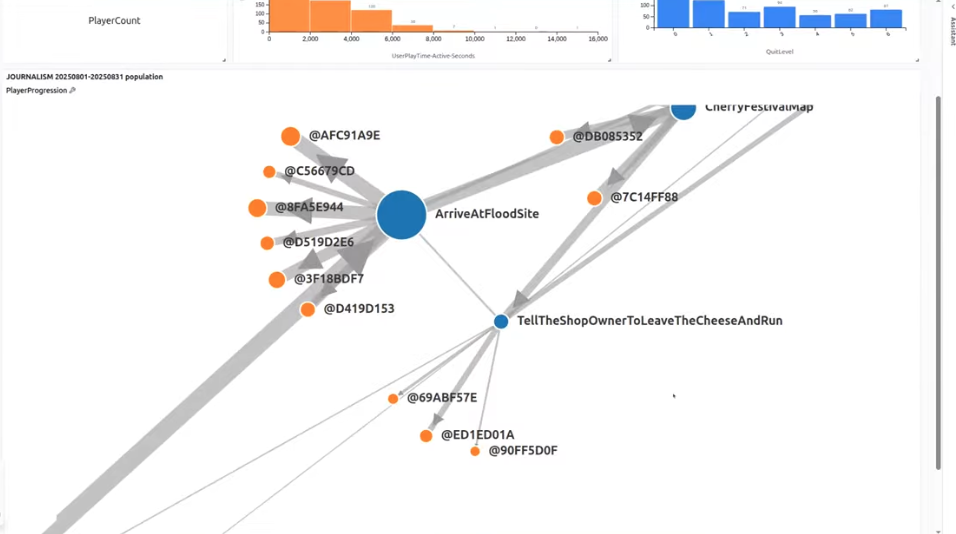
Progression Visualization: Co-design of analytics tools using shared data
Shared game data can serve as a critical input to the development and testing of new research tools. In this interview with Luke Swanson and Zhaoqing (Jimmy) Teng, we explore how progression visualization can be used in learning games research, particularly when games have a non-linear structure. Using the shared gameplay data, Jimmy was able to iterate through versions of the tool, and refine the analysis and user interface. “You can select a specific action and understand, for example, how a player reached this action,” he said. This work was supported by the National Science Foundation, Grant # 2243668

Shadowspect: The Power of Sharing Games
Jenn Scianna started working with Professor YJ Kim on a project investigating how teachers understand persistence in the classroom. They used Shadowspect, a learning game designed by YJ to measure student persistence and spatial reasoning. YJ and Jenn worked with the Field Day team to create a data schema that mapped the existing event logging built into the game, and loaded Shadowspect into the Vault, a game distribution service that also enables the collection of anonymous player data. “So, even though the main research questions had been addressed in the co-design work, the game lives on,” explained Jenn. “Data are still coming in!” This work was supported by the National Science Foundation, Grant # 2243668